
Why Refineries Are Moving to Tank Cribbing Rentals
Why Tank Work Is Changing
Refinery maintenance work is operating under unprecedented pressure. Shutdown schedules are tighter, environmental regulations are stricter, and safety rules are non-negotiable. Because of this, companies are abandoning outdated methods to support floating roofs (FR) during tank work.
Legacy cribbing methods slow down jobs, increase worker exposure, and directly drag down a refinery’s bottom line. Modern operators demand systems that optimize safety, slash project timelines, and maximize asset availability.
The Financial and Environmental Cost of Tank Downtime
When a storage tank goes offline for an API 653 inspection, the financial bleeding begins immediately. Tank downtime results in a massive loss of daily storage revenue and disrupts refinery logistics.
Furthermore, prolonged maintenance increases the environmental footprint of the operation. Extended cleaning cycles, prolonged degassing, and repeated tank disruptions increase volatile organic compound (VOC) exposure risks and waste management burdens. Minimizing time-to-completion isn’t just a scheduling goal; it is an environmental and financial necessity.
The Hidden Perils of Legacy Cribbing & “Imposter” Systems
Traditional wood cribbing has been a staple for decades, but its systemic liabilities are now fully exposed.
- The Timber Problem: Wood stacks are structurally unstable, prone to being knocked over, and require workers to constantly build, dismantle, and re-stack heavy timbers inside confined spaces.
- The “Imposter” Scaffolding Risk: Some facilities have turned to lightweight modular scaffolding systems (such as “Doka” systems) as an alternative. These systems are imposters. They are fundamentally not designed or engineered to handle the severe lateral rotational movements inherent to a failing or shifting floating roof.
When a floating roof shifts, these unproven methods buckle, putting human lives at catastrophic risk.
How Delta P Technology Saves 15–18 Days per Inspection
Time is money, and Delta P Technology drastically optimizes both.
The Metric That Matters: Utilizing Delta P Cribbing Towers saves an average of 15 to 18 days per typical API 653 Inspection.
Where Do the Savings Come From?
- Rapid Relocation: Instead of wasting hundreds of man-hours re-stacking timber blocks 10 to 15 times during a single project, Delta P systems are engineered for rapid, mechanical relocation.
- Compounding Financial ROI: By cutting more than two weeks off the project timeline, refineries completely mitigate massive daily storage revenue losses.
- Reduced Labor and Down-Time: Crews spend less time handling cribbing and more time doing actual mechanical repairs, drastically shortening the asset’s total downtime.
Real-World Proof: 43 Lives Saved by Delta P
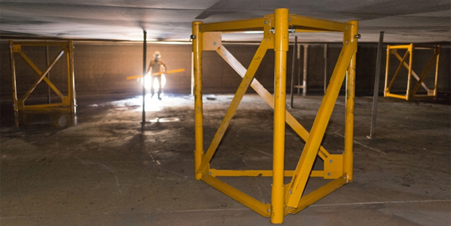
Delta P cribbing towers are proven never to fail. While other materials crush or tip, Delta P towers are engineered to withstand worst-case structural failures and lateral rotational floating roof movements.
To date, there have been eight recorded floating roof failures where Delta P towers and entrants were inside the tank.
43 People Are Alive Today Because of Delta P
Every single one of those 43 entrants walked out of those collapsed tanks safe and sound. Their firsthand accounts of the incidents all share the exact same terrifying, yet triumphant, claim:
- As soon as the floating roof began its violent lateral rotation, the workers ran to the closest Delta P Cribbing Tower and crawled inside the structure.
- They watched the massive steel roof collapse perfectly onto the rigid Delta P towers.
- The towers held the entire weight of the failed roof, maintaining structural integrity and creating a literal safe haven.
- Once the movement stopped, every worker walked out completely unharmed.
Why Rental Systems Are Growing Fast
Refinery operators are moving away from purchasing and storing bulkier support equipment. Rental systems offer ultimate flexibility and ensure that certified, perfectly maintained, high-performance equipment arrives exactly when a shutdown begins.
When evaluating the true cost of a shutdown, modern procurement teams look past the upfront equipment price. They calculate total labor hours, project delays, environmental impact, and worker safety risks. When factoring in the 15–18 days of restored storage revenue, Delta P rentals offer an unmatched return on investment.
FAQs
1. How exactly does Delta P save 15–18 days during an inspection?
Traditional crews must manually tear down and re-stack heavy wood timbers 10 to 15 times as work progresses. Delta P towers are designed for rapid relocation, eliminating hundreds of hours of redundant labor and keeping the API 653 inspection moving seamlessly.
2. Why is scaffolding like “Doka” unsafe for floating roof support?
Generic scaffolding systems are designed for vertical construction loads, not the unpredictable lateral and rotational forces of a shifting floating roof. They lack the engineering required to prevent a twisting roof from collapsing them.
3. What is the financial benefit of switching to Delta P?
By returning a tank to service 15 to 18 days faster, refineries prevent the loss of substantial daily storage revenue and avoid the massive labor costs associated with prolonged shutdown timelines.
4. What is the environmental advantage of this system?
Shorter project timelines mean reduced tank open-time, shorter degassing periods, and lower overall VOC emissions, helping refineries meet strict environmental compliance targets.
5. Has the Delta P system actually been tested in a real collapse?
Yes. In eight distinct floating roof failures, Delta P towers successfully caught and held the collapsing roof. Because of the engineering of these towers, 43 workers survived those structural failures without a single casualty.
Final Thoughts
Refinery maintenance cannot rely on legacy habits when millions of dollars and human lives are on the line. Wood timbers and unproven scaffolding imposters represent an unacceptable risk to safety, timelines, and revenue.
At Delta P Technology, we engineer certainty into refinery shutdowns. By safeguarding workers against catastrophic lateral roof failures and slashing tank downtime by up to 18 days, we ensure your refinery stays profitable, compliant, and-above all-safe.